
How to Manage an SME
1. Managing the finances of an SME is essential to its success
Knowing how to manage the finances of an SME or business is just as important as mastering any technical aspect.
One of the first lessons entrepreneurs learn is that financial management takes up a large portion of their time.
Although business management is a fundamental aspect of our business, we also need to make sound decisions, surround ourselves with competent specialists, and absorb as much knowledge as possible.
2. Useful Recommendations for Managing the Finances of an SME
What are the keys to financial management and financing for the self-employed?
There are numerous concepts, tips, and invaluable insights, as well as certain necessary mindsets.
Here’s a brief summary of the most important recommendations:
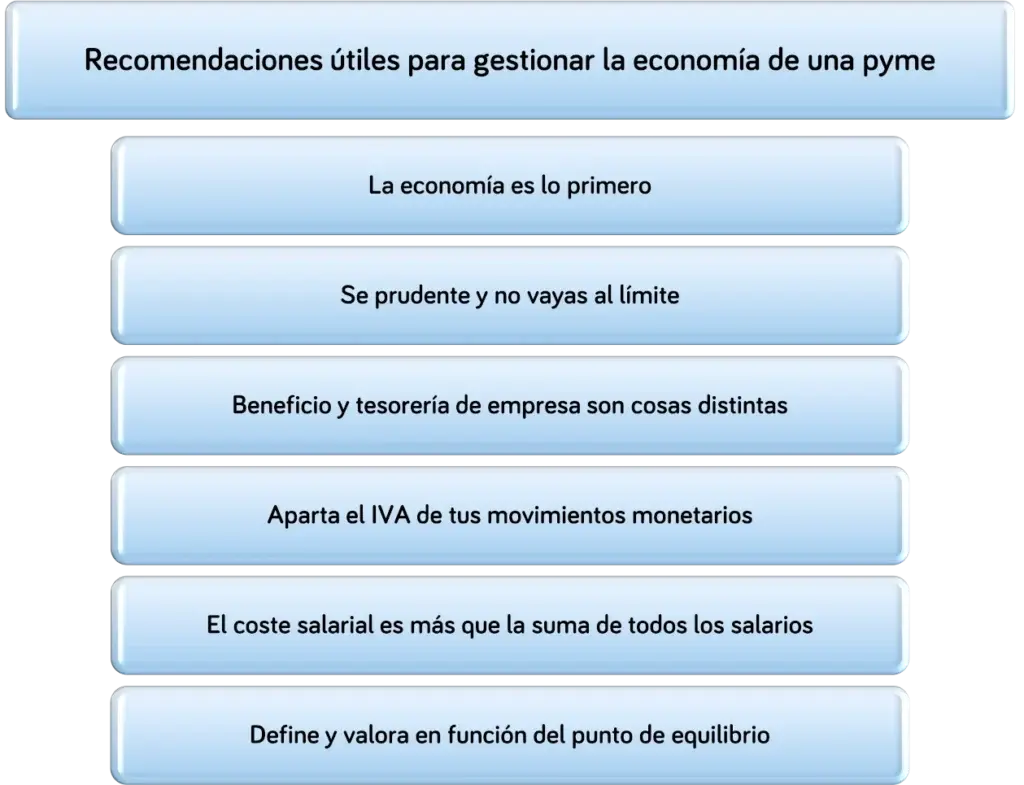
2.1. Finances Come First
Even if your product is wonderful and your customers are the best, if the numbers don’t add up, it’s all for nothing.
Failure is all about the numbers!
That’s why you should surround yourself with expert professionals and take their opinions into account when making decisions.
2.2. Be prudent and don’t push your limits
A company’s cash flow refers to the availability of cash to meet immediate payments.
You should always operate with a financial cushion.
Unexpected events happen: a delay in collections, an unexpected return of an order, an unforeseen expense…
In this context, securing financing before you need it is easier than doing so afterward. Therefore, we recommend that you be prudent and always strive to anticipate potential cash flow shortfalls.
2.3. Profit and cash flow are two different things
This is another concept that can cause you major headaches.
You may have signed a number of major contracts and be working very hard.
However, until you collect payment on them, your company’s cash flow could be in dire straits, and you might not be able to meet your payments to employees, suppliers, and the tax authorities.
The opposite can also happen. You’ve received partial payment on a major invoice and have a good amount of cash on hand, but it’s not enough to purchase the rest of the raw materials you need to fulfill the rest of the order.
In this case, you’ll hardly turn a profit unless you secure good financing for self-employed individuals and businesses.
2.4. Set Aside the VAT from Your Cash Flows
The money you collect as value-added tax isn’t yours. You have to turn it over to the tax authorities at the end of each quarter. If you haven’t factored this in, the discrepancy will be significant.
The same applies to income tax payments for the self-employed.
Business owners and self-employed individuals are merely intermediaries, and while you can always request a payment deferral, the interest charges are substantial.
For this reason, we recommend seeking alternative financing to resolve the issue.
2.5. Labor costs are more than the sum of all salaries
Be careful with this aspect.
Not only because you must take collective bargaining agreements into account and comply with minimum wage requirements, but also because you must consider gross wages—not net wages—and Social Security contributions.
2.6. Define and evaluate based on the break-even point
This criterion is crucial for managing the finances of an SME or a self-employed individual.
The break-even point is the number of products or services you must sell—at the established price and taking costs into account— to turn a profit.
This calculation is essential for managing cash flow, financing, sales targets, headcount, and marketing decisions.
In any case, the main criteria for managing an SME’s finances require common sense, technical knowledge, and some experience. Or, failing that, excellent advice. So, don’t hesitate: surround yourself with the best.
Contact Workcapital—no obligation!
We’d be delighted to help you.