How to Invest in Real Estate

Is it a good idea to invest in real estate? As the popular saying goes, “Don’t put all your eggs in one basket,” so diversifying your investments is very important. Investing in real estate is a strategy that allows you to reduce risk while still earning a high return.
1. What Is Real Estate?
Before considering investing in real estate, you need to understand what it entails. It’s called “real estate” because these are assets that cannot be moved—that is , they are immovable property. This includes buildings, land, fixed structures, and any other property that is attached to the ground. Legally, they are inseparable.
Likewise, seaplanes and boats are considered real estate because they are useless away from the body of water where they operate. On the other hand, mines and railroads also fall into this category, which can generate returns. These structures enable resource extraction and support economic activities. In terms of accounting, they are typically treated as fixed assets.
2. Types of Real Estate
Below we detail the most common types of real estate:
By nature. Such as subsoil and land.
By incorporation. This refers to structures permanently anchored to the ground.
By attachment. Fixed fixtures, such as windows and doors.
By purpose. Improvements that increase the value of the main property, such as a renovation.
By analogy: mortgages.
By representation. Deeds, documents, and records that reflect ownership.

3. Benefits of Investing in Real Estate
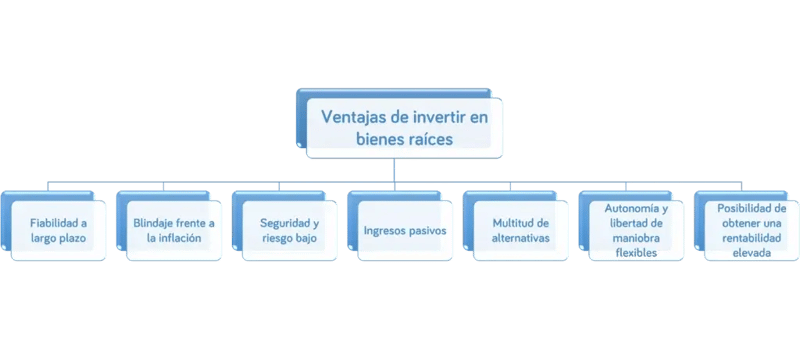
Here are some of the main benefits of investing in real estate:
Long-term reliability.
Hedging against inflation.
Security and low risk.
Passive income, with steady natural appreciation.
A wide range of options.
Flexibility and freedom of action.
Potential for high returns.
4. Tips for Getting Started in Real Estate Investing
If you’ve decided to consider this field as a real opportunity to generate returns for your finances, go for it! Now is the time to learn and do your research to understand exactly how to do it with a guarantee of success.
As you probably already know, this option is more advantageous than saving, given the potential returns. It’s also much less risky than the stock market—even than gold and silver, whose values are far more volatile than those of real estate.
That said, while you don’t have to be a real estate expert to make money this way, it’s a good idea to seek sound advice. If you want to start putting your money to work in this area, you’ll find these tips helpful as you begin investing in real estate.
1. Ten Guidelines for Beginners and Experienced Investors
Below are eight practical principles to improve the return and reliability of these investments:
Establish the goal or objective of each investment. In other words, determine how you plan to use the real estate you purchase: to rent it out, resell it, renovate it, or live in it. The area you choose depends, for example, on this approach.
Choose a professional and experienced real estate agency capable of providing you with favorable options and recommendations. It should be a support, not a burden.
Avoid short-term thinking. Instead, plan for the long term. Immediate returns aren’t always possible. With patience, you’ll earn more.
Observe, analyze, and take advantage of the market. Consider the implications of various factors: location, type of property, surroundings…
Anticipate capital appreciation. A property’s potential increase in value depends on market conditions that you must take into account and interpret correctly.
Be strategic. The obvious choices always cost more. That’s why it’s worth looking for hidden gems—such as older homes in prime locations ripe for restoration or land with greater future potential than it currently shows.
Buy before construction begins. Getting in early and purchasing these properties off-plan is more cost-effective. Consequently, it allows you to achieve higher capital gains.
Make decisions with your head, not your heart. You’re investing to do business, so set aside any considerations outside that scope.
Ultimately, investing in real estate is often a smart way to diversify your income sources while ensuring security and returns. Now, with Workcapital’s guidance, you know how to do it.

Image by vectorjuice on Freepik
Image from Freepik