

Allocation of Company Profits: Reserves and Types

After the end of the fiscal year, companies must decide how to allocate the profit earned during the year. This decision is made at the annual general meeting. Once the decision is made, it is up to the accounting staff to record the allocation of earnings. The most common uses for a company’s profits are reserves , profit distribution , and offsetting losses from prior fiscal years.
In this blog post, we will explore the different types of reserves established in the General AccountingPlan , with a special focus on equalization and capitalization reserves.
1. What Are a Company’s Reserves?
A company’s reserves are accumulated funds resulting from the retention of undistributed profits. They serve as a financial cushion to address contingencies and ensure economic stability.
- Function and Purpose
- The primary role of reserves is to strengthen the financial structure, provide liquidity, and reduce dependence on external financing. They are used for strategic investments, business expansion, or to cover future losses.
- Differences Between Reserves and Other Assets
- Unlike other assets, reserves have no physical form and must be managed prudently to avoid overvaluation. They constitute an essential part of net worth, differing from both tangible and intangible assets.
- Impact on Decision-Making
- Reserves influence corporate decisions. The greater the reserves, the greater the company’s capacity to invest and adapt to market conditions, without compromising dividends or resources allocated to other purposes.
- Reserve Management Strategies
Regular Accumulation: Determine a consistent percentage of profits to be retained annually.
Needs Assessment: Regularly review the adequacy of reserves based on projections and operational needs.
Financial Flexibility: Maintain a balance between dividends and retained earnings, adapting to economic changes.
- Consequences of Poor Management
- Insufficient or overestimated reserves can negatively impact corporate reputation. They can limit investment capacity, erode investor confidence, and increase vulnerability to economic crises.
- The Role of the Legal and Tax Environment
- Tax and legal regulations dictate the conditions for the creation and use of reserves. Companies must comply with these requirements to maximize tax benefits and avoid penalties.
2. Why Do Companies Allocate Profits to Reserves?
Allocating a portion of profits to reserves is a matter of financial prudence. Rather than distributing all profits to shareholders, many companies choose to retain a portion and strengthen their financial structure. This strategy offers several advantages:
-
It ensures long-term solvency
Reserves increase equity, which improves the company’s financial position and its ability to take on debt or weather crises. -
It allows for reinvestment in the business
With available equity, the company can undertake new investments without having to resort to external financing. -
It complies with the law
Some reserves are required by law and must therefore be set aside before distributing profits. -
It builds confidence
A company with well-funded reserves conveys financial strength to investors, financial institutions, and suppliers.
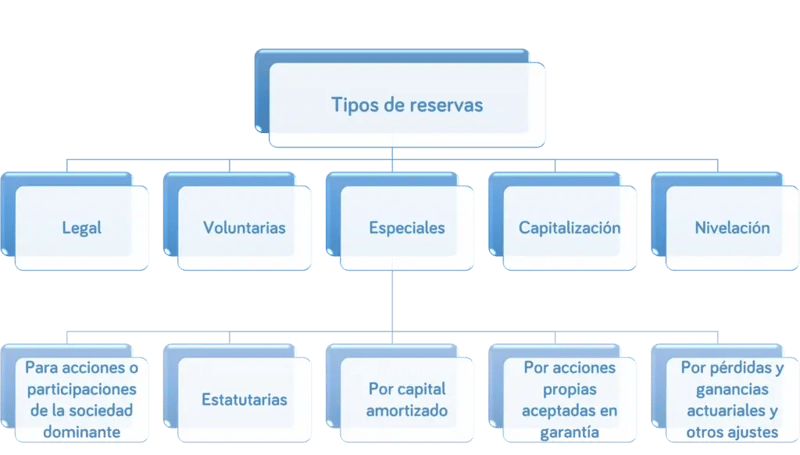
3. Types of Reserves
Legal reserve
This reserve is required by law and stipulates that companies must set aside at least 10% of their profits until the reserve reaches 20% of the company’s capital stock. Its purpose is to provide a solid foundation for the company and to protect the interests of shareholders and related third parties.
Voluntary reserves
These are established voluntarily by the company for the purpose of self-financing. They allow the company to accumulate internal resources for future investments, undertake market expansion initiatives, or address potential contingencies with greater financial autonomy.
Capitalization Reserve
This reserve is established voluntarily and allows companies to save on taxes. They may allocate up to 10% of their profits to this reserve without having to reinvest it in their own assets. As a result, companies can benefit from a reduced tax rate.
Equalization Reserve
This reserve is also voluntary and is intended for companies that qualify for the special small-business tax regime. It allows the positive taxable income to be reduced by 10%, up to a maximum limit of one million euros. The smoothing reserve anticipates the use of negative tax bases that will be generated over the next five years, thereby reducing the company’s tax burden.
Special Reserves
-
- Reserves for shares or equity interests in the parent company: These reserves are restricted and must be established when a company acquires shares or equity interests in a parent company, provided they are not disposed of.
- Statutory reserves: The percentage and purpose of these reserves are established in the company’s articles of incorporation. They may be used for various purposes, such as company growth, investments, or the creation of a contingency fund.
- Reserve for Amortized Capital: This refers to the par value of the company’s own shares or equity interests that are acquired and amortized against retained earnings or available reserves. It also includes amortized shares or equity interests acquired by the company at no cost.
- Reserves for Own Shares Accepted as Collateral: These are established when a company accepts its own shares as collateral. During this period, the reserves are restricted and are intended to protect creditors.
- Reserves for Actuarial Gains and Losses and Other Adjustments: These arise from the recognition of actuarial gains and losses and adjustments to the value of assets related to defined-benefit post-employment benefits for employees. Their purpose is to accurately reflect the company’s financial position.
4. How is the distribution of profits decided?
The decision on how to distribute profits rests with the general meeting of members or shareholders. This meeting is typically held once the financial results for the fiscal year have been approved and, among other matters, determines the allocation of net income: what portion is allocated to dividends and what portion to reserves.
This resolution must comply with current regulations, the articles of incorporation, and, in some cases, the compensation policy agreed upon with the shareholders. It must also take into account the company’s economic and financial situation.
For example, a company with accumulated losses or low solvency will likely choose to bolster its reserves rather than distribute dividends. In contrast, a company in a solid financial position may be able to provide greater returns to its members.
5. How does this affect financial management?
Managing profits and reserves is one of the most strategic decisions a company can make. Here’s why:
-
It influences future financing
The more reserves a company has, the greater its equity, which can make it easier to obtain bank financing or attract outside investment. -
It affects dividend policy
Shareholders must understand that profits cannot always be distributed. Sometimes, it makes more sense to reinvest in the business. -
It strengthens stability during adverse economic cycles
In times of uncertainty, having reserves can mean the difference between surviving or going out of business. -
It enables long-term planning
A company that builds up reserves is better positioned to execute growth plans or seize new opportunities.
In short, the allocation of profits is no minor decision. Setting aside reserves is not only a legal requirement in some cases but also a responsible management practice. Companies that reinvest part of their profits are investing in their sustainability, growth, and adaptability.
Therefore, if you’re an entrepreneur or part of a company’s management team, it’s essential to consider the strategic value of reserves. Furthermore, understanding their types and uses will allow you to make more informed decisions that align with your organization’s long-term goals.