
The Bill of Exchange: What It Is and How It Works

A promissory note is a classic financial instrument that has been used for centuries as a key tool in commercial transactions. Although its origins date back to the 12th century, it remains relevant today for guaranteeing the payment of a debt within a specified time frame. This commercial document not only replaces the use of cash in many cases but also offers a solid guarantee of payment, making it an attractive option for businesses and individuals who want to secure their receivables efficiently.
In this article, we’ll explain in detail the characteristics of a bill of exchange, the parties involved in its issuance, and how it differs from other financial instruments such as a bank promissory note. If you’re interested in learning how this negotiable instrument can help you manage and protect your commercial transactions, keep reading.
1. What Is a Bill of Exchange?
It is an official commercial document, as it is stamped by the government and complies with the requirements set forth in the Bills of Exchange and Checks Act 19/1985.
It can be defined as a commercial document through which an individual or legal entity commits to and is obligated to pay a specific amount of money to another party within a defined period of time.
It is, therefore, a negotiable instrument that certifies and guarantees a debt between the parties involved.
Consequently, its functions include the following:
Means of payment: It replaces cash, just as a bank promissory note does.
Guarantee of payment: The beneficiary of the bill of exchange may take legal action in the event of nonpayment.
2. Characteristics of the Bill of Exchange
The bill of exchange is a financial instrument distinguished by its flexibility and utility in various commercial situations. Understanding its fundamental characteristics facilitates its efficient use in commercial transactions.
Formal Requirements
A bill of exchange must meet essential requirements, such as the identification of the drawer, drawee, and payee, the amount payable, and the due date. The absence of any of these elements may invalidate the document.
Transferability
One of its most notable characteristics is its transferability. Through endorsement, the payee can assign their rights to a third party, thereby allowing the bill to circulate in the market.
Function as Security
In addition to being a means of payment, the promissory note serves as security for the parties involved. In the event of nonpayment, the payee has legal rights to demand fulfillment of the obligation.
Adaptability to Business Needs
There are various types of bills of exchange, such as those payable on demand or at a specified future date, which offer flexibility according to business needs. This adds significant value to international transactions.
Geographic Coverage
Thanks to its global acceptance, the bill of exchange is an essential tool for merchants operating in different countries, thereby facilitating international trade with uniform standards.
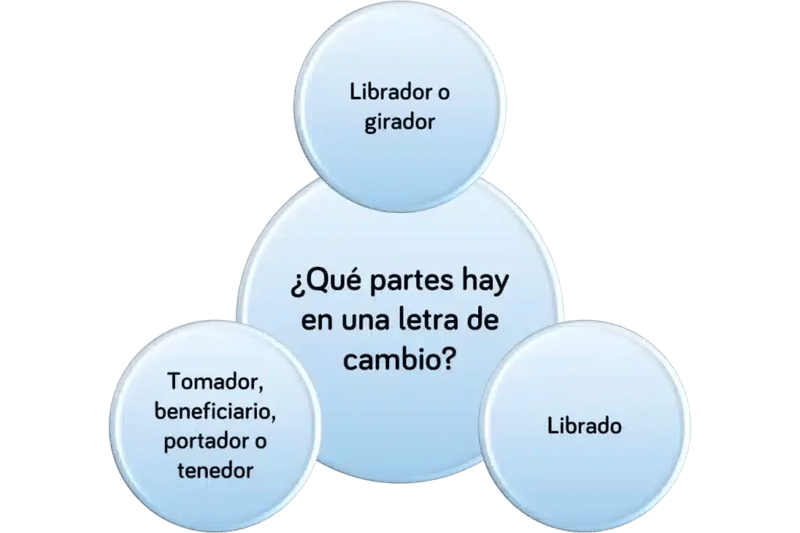
3. Parts of a Bill of Exchange
It has several fundamental elements that define it and make it valid. Understanding its components is key to understanding how it works. The main ones are:
Drawer: This is the person who issues the bill of exchange and orders payment. This is the party with the debt that must be settled through this instrument.
Drawee: This is the person or entity ordered to make the payment—that is, the party responsible for paying the amount specified in the bill of exchange.
Beneficiary: This is the person or entity to whom payment is due. Generally, the beneficiary is a third party entitled to receive the amount specified in the bill.
Amount of money: This is the sum of money that must be paid. This amount must be clearly stated on the promissory note.
Maturity date: The day on which payment must be made. It may be a specific date or, in some cases, a specified period from the date of issuance.
Place of payment: The location where payment must be made, which may be specified in the bill of exchange.
Drawer’s signature: The drawer’s signature is essential, as it validates the document and lends it legitimacy.
4. How a Bill of Exchange Works
Although the process of using a promissory note is fairly simple, it involves a series of steps that ensure the obligation is fulfilled. Below, we detail how it works in practice:
Issuance: The drawer issues the bill of exchange in favor of a payee. In this step, the drawer specifies the amount of money the drawee must pay on a specific date. It is important that this document be clear and precise regarding the terms, as any error could invalidate the agreement.
Acceptance: The drawee has the option to accept the promissory note. If the drawee accepts, this means they agree to pay the specified amount on the stipulated date. If they do not accept it, the agreement is not valid, and the process will not continue.
Endorsement: If the payee decides to transfer the right to collect on the promissory note to another person, they may do so by means of an endorsement. An endorsement is a procedure by which the payee signs the back of the bill and transfers the right to collect to another person, who then becomes the new payee of the bill.
Collection: The payee or the person to whom the bill has been endorsed may present the bill of exchange to the drawee on the due date to request payment. If everything is in order, the drawee will proceed to pay the stipulated amount.
Payment: Payment can be made in various ways, depending on what the parties agree: in cash, by bank transfer, or by other means. Once payment is made, the drawee is released from their obligation, and the process is concluded.
5. Types of Bills of Exchange
There are different types used depending on the needs of the parties involved. Some of the most common types are:
Simple bill of exchange: This is the most common form. It stipulates that the drawee must pay the indicated amount on a specific date.
On-demand bill of exchange: In this case, payment must be made immediately upon presentation of the bill. This is a more flexible type of bill of exchange, as there is no specific due date; rather, payment is due upon presentation of the document.
Installment bill of exchange: Instead of a single payment, payment is made in several installments over a specified period. This type of bill is used when the debt cannot be paid in a single lump sum but must be paid in installments.
Negotiable bill of exchange: This type of bill of exchange is transferable. The payee can endorse it to a third party, who then becomes the new holder of the bill. This makes the bill of exchange very useful in commercial transactions, as it can circulate among different parties.
6. Advantages and Disadvantages
Advantages of Using a Promissory Note
It offers several advantages for the drawer, the payee, and the drawee. Below, we highlight some of the main ones:
Security: It is a legally binding document, which guarantees that payment will be made according to the agreed-upon terms. If payment is not made, the affected party can take legal action to enforce compliance.
Ease of Transfer: Thanks to endorsement, a promissory note is a transferable instrument, making it a highly flexible and useful tool in commercial transactions. This ability to transfer the debt to another party can be a significant advantage.
Flexibility: The promissory note can be tailored to the needs of the parties involved. It is possible to agree on payment terms, conditions, and other details based on the circumstances of the transaction.
Formal Structure and Transparency: As a formal document, the promissory note clearly and precisely sets forth the terms of payment, thereby avoiding confusion or misunderstandings.
Disadvantages of the bill of exchange
Although it is a very useful tool, it also has some disadvantages that should be considered:
Dependence on the Drawee’s Acceptance: If the drawee does not accept the promissory note, payment cannot proceed, which can cause problems.
Risk of Nonpayment: Despite its formal nature, there is always a risk that the drawee will fail to make payment by the established date. If this occurs, the payee must resort to legal action to enforce payment.
Legal Proceedings: In the event that payment is not made, legal proceedings can be complicated and costly, especially if the parties are located in different jurisdictions.
7. Difference Between a Bill of Exchange and a Promissory Note
The difference between a bill of exchange and a promissory note lies in several aspects that go beyond their technical definitions. Both are used as instruments to formalize a promise or obligation to pay, but each has unique characteristics that make them more suitable for certain contexts.
Origin and Historical Evolution
The bill of exchange has a long history in commerce and finance, originating in the Middle Ages to simplify commercial transactions. The promissory note, a more recent development, was designed to be a simpler and more straightforward document, facilitating agreements between two parties.
Formalities and Complexity
A bill of exchange is typically more formal and requires compliance with specific legal requirements, including the use of stamped paper. In contrast, a promissory note involves fewer formalities, allowing for greater flexibility in its drafting.
Flexibility and Common Uses
The promissory note is preferred in situations where a relationship of trust is paramount, such as personal loans. The bill of exchange, on the other hand, is preferred in more complex transactions involving multiple parties, such as international business or large commercial agreements.
Legal Implications
Legally, the difference lies in their binding effect on the parties. A bill of exchange, being an order to pay, legally binds the acceptor once it is signed. A promissory note, despite being less formal, remains a legally binding document but only commits the issuer to future payment.
Impact on Accounting
For those who handle accounting, understanding the difference between a bill of exchange and a promissory note is crucial, as it influences how a debt is recorded in the books and the tax treatment applicable to each.
In conclusion, although both documents serve to formalize a debt, their differences must be considered in both business and personal contexts, taking into account factors such as the desired level of formality, the parties involved, and the nature of the financial commitment.