
What is cash flow, and how does it affect a company's viability?
1. Cash Flow for Managing a Business
Cash flow is one of those English terms that is essential to understand when managing a business.
Not surprisingly, it’s a fundamental concept in the economics and financial analysis of any business organization.
To strengthen and safeguard your company’s viability, you must continuously educate yourself.
In this context, cash flow plays a fundamental role in the economic future and financing of any company.
2. What Is Cash Flow?
This term is part of the everyday vocabulary of any accountant or financial manager at a company.
If you’re self-employed and keeping track of your business’s viability, you’ll come across it before long.
Cash flow refers to the inflow and outflow of cash and is characterized by:
– Being an indicator of the company’s liquidity.
– It takes into account cash inflows and outflows.
– Focusing on a specific period of time.
It therefore reflects your business’s ability to generate liquidity and meet its payment obligations.
This basic information is key to deciding whether to seek business financing.
Believe it or not, having this information is crucial for analyzing a company’s viability.
In this regard, it’s possible for a company with strong financial results to lack the liquidity needed to meet its immediate payments and, as a result, could be doomed to bankruptcy if it doesn’t find a financing solution tailored to its needs.
3. What Types of Cash Flow Are There?
It’s important to distinguish between these three types of cash flow:
– Operating. This focuses on ordinary revenue—that is, revenue derived from your business’s core activities. Specifically, the provision of services or the sale of products.
– Investment. This covers cash flows from the organization’s real estate or financial investments.
Financing. This applies to financing activities for companies that affect their equity and accumulated debt.
4. What is the cash flow formula?
Within the period in which you are analyzing the company’s viability, you need to add up these financial elements:
– Net income.
– Depreciation and amortization.
– Provisions.
Keep in mind that the resulting figure may not match the company’s net income.
Imagine, for example, that you have several significant unpaid invoices from customers. In theory, from an accounting standpoint, you might be showing excellent results. However, your cash flow could be running dry, and without business financing, you’ll be in trouble.
That’s why we recommend that you calculate this figure regularly to ensure your business is running smoothly.
This metric is perfect for reassuring you and reinforcing your good work—or, if necessary, for knowing that corrective measures need to be taken.
Now,
what should you do if your cash flow is sending warning signs?
5. Best Practices for Improving Cash Flow
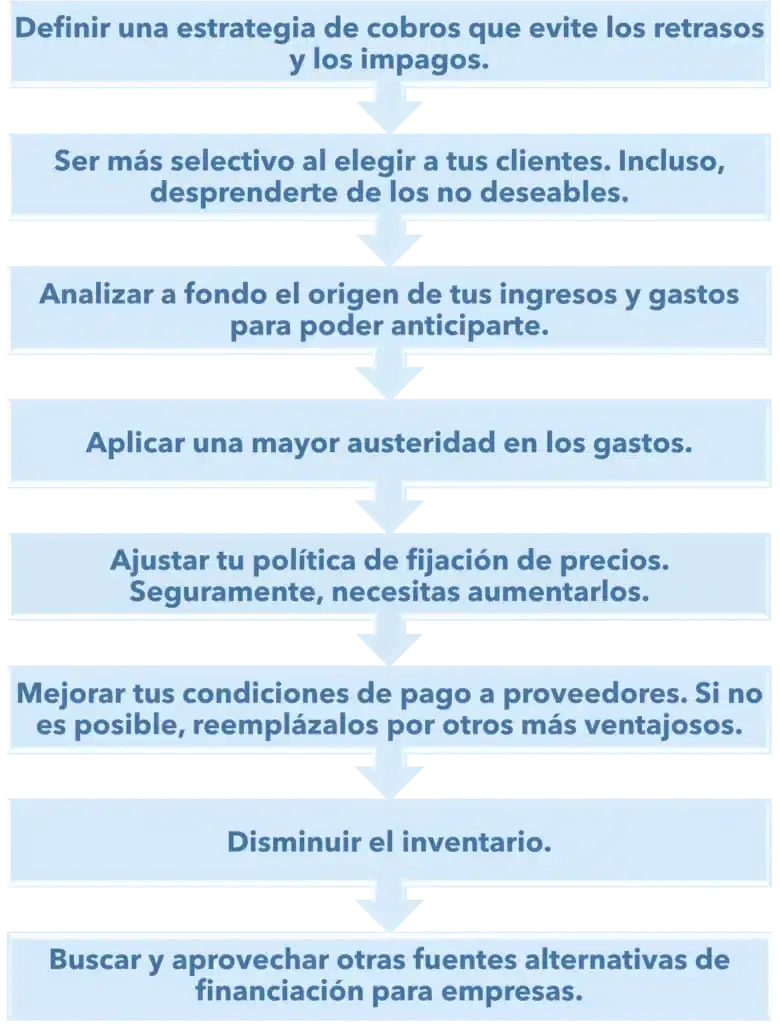
Essentially, negative cash flow indicates a mismatch between available funds and immediate payments that must be made. If you find yourself in this situation, we recommend implementing the following measures:
1. Develop a collections strategy to prevent delays and non-payments.
2. Be more selective when choosing your customers. You may even need to let go of undesirable ones.
3. Thoroughly analyze the sources of your revenue and expenses so you can plan ahead.
4. Be more frugal with your expenses.
5. Adjust your pricing policy. You’ll likely need to raise your prices.
6. Improve your payment terms with suppliers. If that’s not possible, replace them with more favorable ones.
7. Reduce inventory.
8. Seek out and take advantage of alternative sources of business financing.
6. Three Good Business Financing Options That Improve Cash Flow
Have you ever used promissory note discounts, factoring, or invoice advances?
Using these tools has a direct impact on improving cash flow.
Essentially, these tools allow you to receive payment for your receivables earlier. This way, you have liquidity when you need it and can meet your payment obligations.
Here’s a brief explanation of the instruments mentioned above:
– Discounting promissory notes. An intermediary company discounts the receivable before maturity in exchange for a fee.
– Confirming. Your supplier arranges with a financial institution for the advance payment of its invoices to suppliers in exchange for a small percentage.
– Invoice advance. The financial institution pays you the full amount of the invoice, minus a small fee, before it is due.
Is it clear to you now what cash flow is and how it affects your business?
Remember that alternative financing can be a valuable ally in ensuring your project’s liquidity.
At WorkCapital, we tailor our financial products to your business’s needs.
Get in touch with us and ask us any questions—no obligation!