
1. Public Bidding with Government Agencies: Pros and Cons
Public tenders are the mechanism used by government agencies to procure products, services, or construction projects.
They are a good business opportunity in times of crisis because they stimulate the economy and provide a lifeline to companies.
Companies often turn to this type of public tender because they know that government agencies always honor their payment commitments.
However, as we’ll see, there are a number of pros and cons to bidding on public contracts.
2. Public Tender: What It Is and How It Works
A public tender is an administrative procedure through which a government agency or public-sector entity opens a “tender” (process) to contract with private companies for the execution of a project, the provision of a service, or the supply of goods.
Submission of bids is open to all self-employed individuals, small and medium-sized enterprises (SMEs), and large companies that meet the eligibility requirements for contracting.
To comply with the principles of transparency, publicity, equality, and free competition that govern these administrative acts, terms and conditions (contract specifications) are established, setting forth the requirements for participants and the economic and technical conditions of the contract being put out to bid.
Currently, the bidding process in Spain is regulated by Law 9/2017 of November 8 on Public Sector Contracts and its subsequent amendments.
This law sets forth the set of rules and regulations governing public tenders.
3. How These Public Procurements Work
As mentioned, public administrations operate under a series of well-defined rules.
Thus, depending on the services required, the amount, and other characteristics, certain award procedures are established.
The award procedure is the set of legal steps established for selecting a contractor; in other words, it is the process you must go through to become a government supplier.
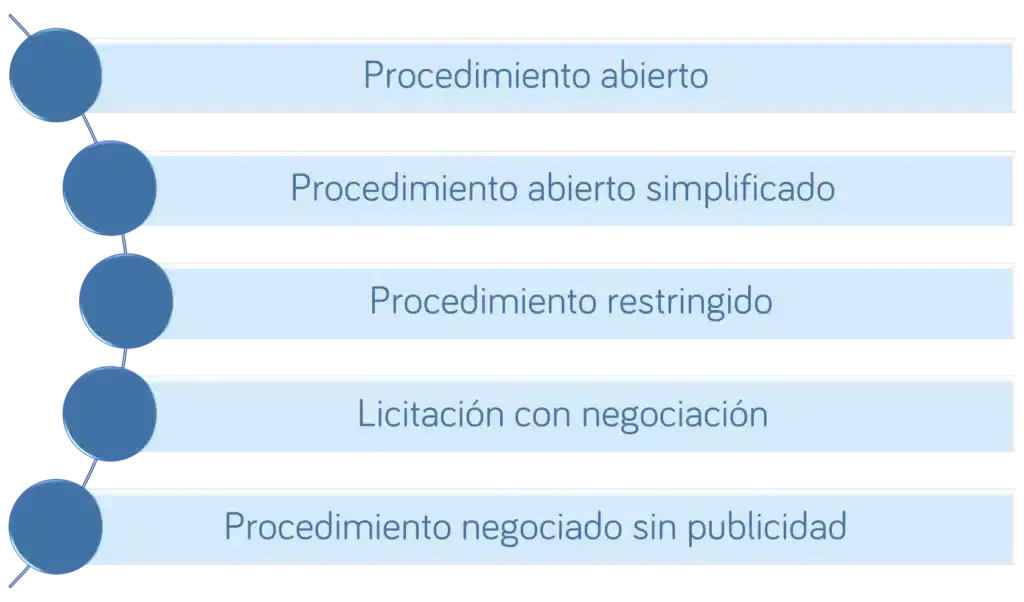
The most important types of procedures are:
1. Open procedure: In this procedure, all economic operators may submit a bid, and any negotiation regarding the terms and conditions of the contract is excluded.
2. Simplified open procedure: This is a faster version of the open procedure in which economic operators must be registered in the Official Registry of Bidders and Classified Companies, or in the equivalent registry of the Autonomous Communities.
3. Restricted procedure: Any economic operator may request to participate in a restricted procedure, but only those selected by the contracting authority may submit bids.
4. Competitive bidding with negotiation: In competitive bidding with negotiation, any economic operator may request to participate, but only those who are preselected will be invited to submit bids and negotiate.
5. Negotiated procedure without prior publication: This is a negotiated procedure that is not subject to prior publication. This procedure may only be used on special occasions.
4. Pros and Cons of Public Bidding
Working for the government can be very beneficial for your company, since you’ll know your profit margins in advance.
However, it’s not all positive.
There are also some drawbacks that you’ll need to accept and compensate for if you choose this business approach.
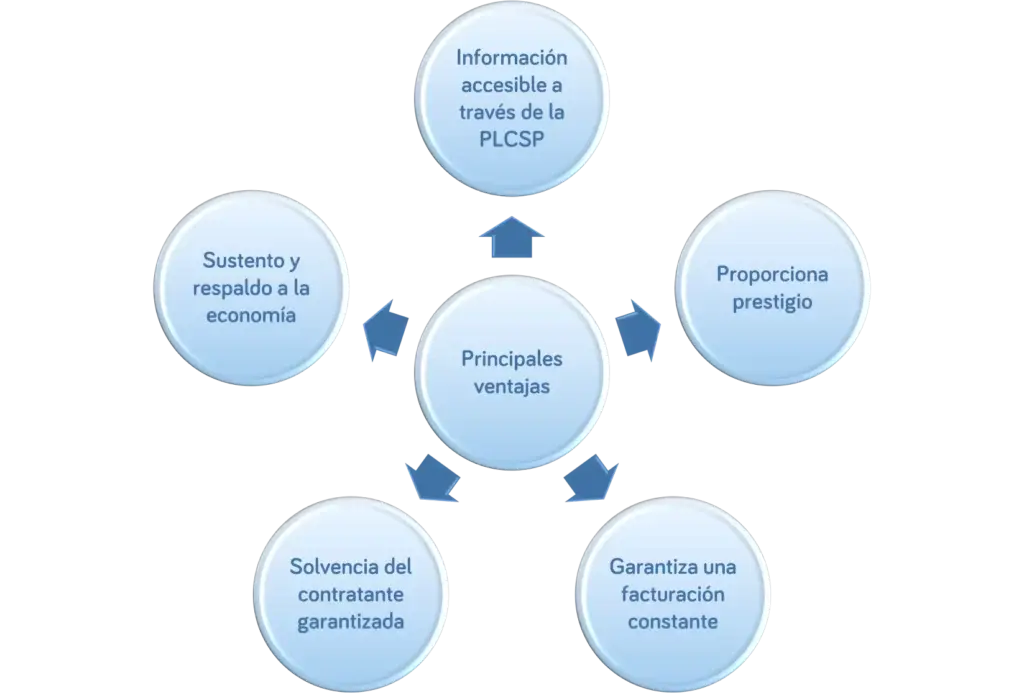
4.1 Advantages of public procurement
Here are the main ones—take note:
- 1. Information accessible to all types of companies through the PLCSP
- 2. It provides prestige as well as valuable contacts.
- 3. Guarantees steady revenue throughout the contract period.
- 4. The contractor’s financial stability is generally guaranteed.
In times of crisis, public investments provide support and stability to the economy.
4.2 Disadvantages of these public contracts
What are the drawbacks you should be aware of?
We’ll list them right now:
1. The bureaucratic and administrative work required to submit a bid is exhaustive, time-consuming, and labor-intensive.
Although it’s true that you can often reuse content and documents from other public bids, preparing the submission requires a significant time investment (sometimes with no return on that investment).
In this regard, it’s very important to calculate your bid amounts at the lowest possible cost so that the contract is viable and profitable; otherwise, you’ll be making an unreasonably low bid and will have to explain yourself to the government.
2. The system is inflexible: if you are awarded the project, you must carry it out exactly as defined.
However, reality sometimes differs from what was estimated in the project, which can reduce its productivity or efficiency.
3. You may face penalties if the initial terms are not fully complied with.
4. Payments are received late, usually after at least six months, which can cause cash flow problems.
5. Even if you satisfy the client, once the project is completed, you’ll have to bid again and run the risk of not being awarded the contract a second time.
In short, public bidding is an interesting option for your business, but you shouldn’t enter the process lightly.
We recommend that you create a well-designed business plan, as it’s not advisable to rely solely on the government.
If you decide to pursue the public sector, at WorkCapital we can help you by advancing payment on invoices from any public agency.

Call us and we’ll give you more information with no obligation!
Image by Racool_studio on Freepik
Image by pch.vector on Freepik