
What is a "toma de razón"?

💬 Here's everything you need to know about the "toma de razón"
📘 What is a “toma de razón”?
A “toma de razón” is an administrative act through which a public or private entity officially records a document or contract in its books or accounting systems.
It serves to validate, monitor, and track actions or agreements that create rights or obligations.
🧾 What is the purpose of registration in a company?
Its main purpose is to ensure the transparency and traceability of financial or legal transactions.
It ensures that every transaction—such as a contract, invoice, or resolution—is properly recorded and acknowledged within the organization.
🏛️ In what areas is the “toma de razón” used?
Posting is applied in various contexts:
— In accounting, to record financial documents.
— In public administration, to validate resolutions or decrees.
— In private companies, to document contracts, transfers, or commitments.
📑 Who performs the entry?
It depends on the type of entity:
— In the public sector, it is performed by the auditing body or the relevant administrative registry.
— In private companies, it may be carried out by the accounting or legal department, depending on the type of document.
💡 Why is recording a document important?
Because it provides legal and accounting support for administrative and financial transactions. Additionally, it ensures that every transaction is recorded and verified, preventing errors, duplications, or irregularities that could affect internal or tax controls.
🧮 What is the difference between recording and posting?
Recording involves noting down a transaction or document, while formal entry officially certifies and validates that the transaction complies with all legal or accounting requirements.
In other words, every certification is a record, but not every record constitutes a certification.
🕒 When should an entry be made?
It must be performed at the time an act or contract is approved or formalized, before its execution or payment. This ensures that the transaction is authorized and correctly recorded within the accounting or administrative system.
The “toma de razón” is one of those technical concepts in receivables management that only specialists fully understand. Often, a lack of familiarity with the terminology means missing out on certain valuable opportunities for your business.
It is therefore important to have a clear understanding of all options before making decisions or signing any agreements. For this reason, it’s best to consult with financial management experts who can advise you.
💡 What is a “toma de razón”?
A “toma de razón” is a crucial administrative process in financial management that focuses on formalizing the assignment of collection rights to a financial institution. This process allows companies—especially those that interact with the public sector—to ensure a more stable cash flow.
Importance in Receivables Management
The “toma de razón” not only speeds up the process of obtaining financial resources but also contributes to a company’s operational stability. This is vital for suppliers facing extended payment terms from public administrations.
Key Elements of the Acknowledgment
- Formal Request: It is essential to submit a formal request for recognition along with the invoice.
- Inclusion of Important Information: Details such as the invoice number, dates, and the issuer’s name must be included.
- Signatures: The signatures of all parties involved must be present, certifying the assignment of the receivable.
Legal Context
Within the legal framework, the acknowledgment of debt must strictly adhere to current regulations to be valid. Complying with these regulations ensures that the agreement is recognized in any legal dispute and facilitates future financial transactions.
Final Considerations
For companies that frequently engage in credit transactions, understanding what an acknowledgment of debt is is of the utmost importance. It improves financial planning and minimizes risks associated with late payments. Thus, the acknowledgment of debt becomes not only a financial tool but also a mechanism for security and financial planning for companies.
🔍 Types of Provisional Entries
There are two types of credit entries:
— Recurring: Applies to all invoices or work certificates included in the agreement, starting from the date of assignment.
— One-time: Applies only to a single invoice or a specific work certification.
✍️ How are entries recorded?
You must always document them in writing. The following methods are valid:
— An email.
— A document attached to the invoice.
— A note on the back of the invoice.
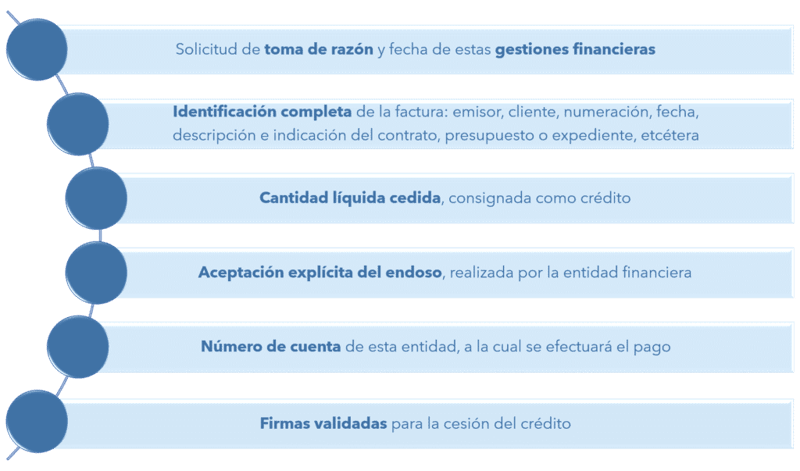
The information that must be included is clearly defined. Generally, it consists of:
— A request for acknowledgment and the date of these financial transactions.
— Complete invoice details: issuer, customer, invoice number, date, description, and reference to the contract, quote, or case file, etc.
— Net amount assigned, recorded as a credit.
— Explicit acceptance of the endorsement by the financial institution.
— Account number of this financial institution, to which payment will be made.
— Validated signatures for the assignment of the receivable.
In short, registration is a procedure used infactoring services that guarantees the proper assignment of the receivable.
📌Types of registration and methods of receivables assignment
This section examines the various types of registration, as well as the methods associated with the assignment of receivables. This is essential for understanding the flexibility and application of these mechanisms in a financial context.
One-Time Registration vs. Recurring Registration
Invoice registration can be classified into two main categories: one-time and recurring. The first is used for specific invoices or statements, allowing the company to obtain financing for a specific amount. This approach is appropriate when liquidity is needed on an ad hoc basis.
On the other hand, recurring factoring is established as a general framework for all invoices or certifications generated within a specific period. It facilitates continuous access to advance funds, eliminating the need to repeat the procedure for each invoice.
Assignment of Receivables and Endorsement in Factoring and Promissory Note Discounting
Credit assignment is a mechanism that allows companies to transfer their collection rights to a financial institution. In this context, factoring becomes a popular option. It consists of selling accounts receivable to an entity that handles the collection process.
The endorsement of promissory notes, on the other hand, refers to the transfer of the right to collect through a promissory note. This method is useful for quickly and easily monetizing debts.
Invoice and Promissory NoteAdvances: Differences and Financial Applications
Invoice advances and promissory note discounting are financial instruments that offer solutions to businesses. However, there are key differences between the two. Invoice advances allow companies to receive immediate funds against accounts receivable, without waiting for the established payment terms to expire.
In contrast, discounting promissory notes involves handing over a promissory note to a financial institution in exchange for liquidity before its maturity date. Both tools are strategic for improving cash flow and addressing late payments in the public sector.
📈 Advantages and Challenges in Receivables Management Through Book Entry
The “toma de razón” process presents both opportunities and challenges for companies that do business with the public sector. These advantages and challenges affect their receivables management and financial operations.
Improved Liquidity and Early Collection
One of the main advantages of this mechanism is the ability to quickly access liquidity. Companies can obtain immediate funds, which allows them to:
— Reduce their dependence on the payment terms set by government agencies.
— Manage their financial and operational obligations more efficiently.
— Invest in new projects or cover unforeseen expenses without having to wait for extended periods.
Risk reduction and administrative simplification
This approach allows companies to minimize the risk associated with nonpayment. By assigning their collection rights:
— Financial institutions take charge of managing collections, which simplifies the administrative burden.
— It allows companies to focus on their core operations without diverting resources to debt collection.
Challenges Arising from Late Payments and Delinquency in the Public Sector
Although the acknowledgment of debt has undeniable advantages, it also faces significant challenges. Delinquency and late payments by government agencies create a complicated environment. Among the most notable problems are:
— Financial instability that can arise from delays, even when “taking note” agreements are in place.
— The need for strict compliance with regulations to ensure that the process is valid and successful.
— The possibility that, despite acknowledging the debt, companies may still face difficulties in collecting payments on time.
At Workcapital, we can help you manage these financial matters; feel free to contact us for a no-obligation consultation.