
Stamps on Promissory Notes: What They Are, When to Pay Them, and What They're For

💬 Here's everything you need to know about endorsements on promissory notes
❓ What exactly are stamps on a promissory note?
Stamp taxes are taxes levied on certain commercial documents, such as promissory notes. They serve to authenticate the document for tax purposes and ensure its validity in enforcement proceedings.
🧾 Why do some promissory notes require a stamp duty and others do not?
Promissory notes payable to order generally require a stamp duty because their nature allows for endorsement and the transfer of the right to collect. In many cases, promissory notes not payable to order are exempt, although this depends on their use and the type of transaction.
📅 When must the stamp tax on a promissory note be paid?
It must be paid at the time the document is issued or, at the latest, within the legal deadline established by the tax authorities. Issuing a promissory note without a revenue stamp when it is required may result in penalties.
⚠️ What happens if a promissory note does not have the required revenue stamp?
The promissory note remains valid as a debt instrument, but it cannot be used directly in enforcement proceedings until the revenue stamp is affixed. Additionally, it may result in fines or surcharges for tax noncompliance.
🔍 How is the stamp duty cost calculated for a promissory note?
The cost depends on the amount of the promissory note and is calculated using a flat or proportional rate. The higher the value of the promissory note, the higher the stamp duty.
🛠️ Who is responsible for paying the stamp duty?
Generally, the issuer of the promissory note, although in practice this can be agreed upon by the parties. It is customary for the payee to verify that the document is properly stamped.
📈 Does the stamp duty affect the discounting process for promissory notes?
Yes. To discount a promissory note payable to order, it must be properly stamped. If it is not, the financial institution may require the tax to be paid before accepting the transaction.
🧭 Why is it important to check the tax stamp before accepting a promissory note?
Because it ensures that the document can be used to claim payment without legal issues, avoid penalties, and streamline discounting or financing processes.
When you work with promissory notes as a form of payment, there are technical concepts you should understand clearly. One of these is stamp duty on promissory notes—a tax requirement that many companies are unaware of but that can have legal and financial implications.
In this article, we explain what stamp duties are, how they’re applied, how they’re calculated, and what you need to keep in mind to comply with current regulations and avoid penalties. We also explore their relationship to alternative financing, such as the discounting of promissory notes.
📘 What Are Stamp Duties on Promissory Notes?
When discussing promissory notes in a business context, one of the concepts that often raises questions is the stamp duty. Although it may seem like a simple administrative detail, it actually has significant legal implications.
Stamps on promissory notes are related to the Tax on Documented Legal Acts (AJD), and their presence or absence on the document can determine whether you are properly complying with your tax obligations. Specifically, this tax applies to promissory notes issued “to order,” as they are transferable by endorsement.
This means that if your company issues or receives a promissory note to order without having properly stamped it, you could face financial penalties. Therefore, it is essential to know when stamping is required and how it should be applied.
📋What is the purpose of tax stamps on promissory notes?
Promissory notes are documents that formalize a promise to pay. When a company issues one, it commits to paying a specific amount on a specific date. But did you know that in many cases they must include tax stamps?
Stamps on promissory notes are linked to the Tax on Documented Legal Acts (AJD), which is levied on certain documents with legal or economic value, such as bills of exchange or promissory notes. Although failing to include them does not invalidate the document, it can result in penalties if the tax authorities detect the omission.
📌 Key Points to Consider
Here are some useful recommendations to better understand the use of revenue stamps:
-
If the promissory note includes the “to order” clause, it is subject to stamp duty.
-
“Not to order” documents are exempt, even if the credit can still be assigned.
-
Stamp duties are not a bank fee, but a tax obligation.
-
In the event of nonpayment or an audit, penalties may be imposed on both the issuer and the party negotiating the instrument.
✒️ Stamp Duties on Promissory Notes to Order
Understanding the importance of stamp duties on promissory notes payable to order is crucial for any entity that handles transactions using these documents.
Impact on Tax Traceability
Stamps play an essential role in the tax traceability of promissory notes. Because they are subject to tax, they allow authorities to ensure that transactions have been properly recorded and taxed.
Strategies to Minimize Costs
Companies can minimize costs related to tax stamps through financial planning. Using larger promissory notes can reduce the frequency of issuance and, consequently, the associated administrative costs.
Consolidation of Promissory Notes
Consolidating payments into a single promissory note can be an effective strategy, though it must be done with caution so as not to compromise liquidity.
Choice of Clauses
Deciding whether a promissory note is payable to order or not can affect stamp duty. Promissory notes that are not payable to order may reduce rates, given their restrictions on endorsement.
Legal Considerations
Failure to comply with stamp tax regulations can have severe legal implications. It is vital for companies to stay abreast of current tax laws, and it is advisable to seek specialized legal counsel.
Supply Chain Optimization
Efficient management of promissory notes, including stamp duty, can significantly improve cash flow and relationships with suppliers, which in turn optimizes the entire supply chain.
🚫 What about a promissory note “not to order”?
When it comes to stamps and the taxation associated with promissory notes, it is important to distinguish whether the document is a promissory note “to order” or “not to order.” The latter—the promissory note not to order—means it cannot be transferred by endorsement, but only through ordinary assignment. This means that the recipient of the promissory note must formally notify the signer of the assignment.
This distinction can have both legal and tax implications. For example, in many cases, non-negotiable promissory notes may be exempt from stamp tax, provided certain requirements are met and it is demonstrated that they are not of a commercial nature.
Therefore, when handling promissory notes—especially in discounting transactions—it is essential to know their type and whether or not they are subject to stamp tax. If you’d like to learn more about the legal requirements for a promissory note, you can read this article on the legal requirements for a promissory note.
⏰ When must stamp taxes be paid?
Stamp duty is mandatory only for promissory notes that include the “to order” clause—that is, those that can be endorsed to a third party. In this case, the document must have the corresponding tax stamp affixed to it to comply with current regulations.
On the other hand, “not to order” promissory notes, which can only be transferred by formal notification to the debtor, are exempt from this tax. This type of promissory note is common in more tightly controlled financial transactions, as it cannot circulate freely.
It is important to note that, although an unstamped promissory note remains valid and enforceable in court, the Tax Agency may impose penalties on anyone who negotiates or transfers it without having complied with the tax requirement. Therefore, this is not a minor issue and should be handled properly.
📐 How is the postage calculated?
The stamp tax is calculated based on the face value of the promissory note and its maturity date. If the maturity date is more than six months, a formula is used that considers twice the amount for tax purposes.
In general, the calculation is performed by applying a tax rate to the taxable base. The tax rate and the stamp tax amount are governed by current tax regulations, and there are official tables that indicate the exact amount based on the value of the promissory note.
In addition, if multiple promissory notes are issued as part of the same legal transaction (for example, a transaction split into multiple maturities), a consolidated tax calculation may be required. This requires careful review to avoid errors or double counting.
However, there are factors that can affect the amount:
— If the promissory note’s maturity exceeds six months from the date of issuance, the tax base is doubled.
— When multiple promissory notes are part of the same legal transaction and reduce the stamp tax due, the difference must be paid.
— This splitting is permitted only if the maturity dates are more than 15 days apart.
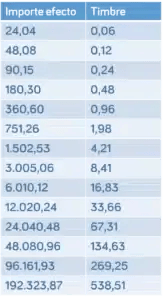
Enter the promissory note face value to calculate the stamp duty amount:
(*) Direct debit payments and promissory notes not made out to order are not subject to stamp duty.
⚠️ What happens if the stamp tax isn’t paid?
Failure to pay the applicable stamp tax may have financial consequences for the company. The Tax Agency may consider this a tax violation and demand payment of the tax along with late-payment interest and possible penalties.
Although the promissory note remains valid as an enforceable instrument (i.e., it can be enforced in court), the problem arises in the tax sphere. Failure to affix the stamp duty does not invalidate the document, but it can affect financial operations, especially if the promissory note is to be discounted at a financial institution.
Furthermore, if the promissory note is negotiated or assigned without complying with the stamp duty requirement, liability may fall on the issuer, the beneficiary, or the financial institution that discounts it. Therefore, it is essential to act prudently and consult with an advisor if there are any doubts.
💼 How does this affect the discounting of promissory notes?
If your company uses the discounting of promissory notes as a financing method, the issue of the revenue stamp becomes even more important. Financial institutions that provide this service typically require that the promissory note be properly stamped if it is a document payable to order.
Discounting promissory notes allows you to obtain immediate liquidity without having to wait for the document to mature. It is a very useful tool for small and medium-sized businesses that need to finance their working capital. However, properly drafting the promissory note is key to ensuring the transaction is viable.
At Workcapital, for example, we offer agile and 100% digital solutions to receive advance payment on promissory notes, as well as other options such as factoring or invoice advances. We always verify that the documents comply with current regulations, including tax requirements such as stamp duty, to ensure legal certainty and prevent problems for our clients.