Types of Invoices and Invoice Requirements
Collecting payments on invoices is the primary operational goal of any business.
Making money and turning a profit are essential to continuing to operate.
In fact, if you work very hard but don’t get paid—or get paid too late—the viability of your business is at risk.
Receiving advance payments on invoices is a valid solution in many cases, because you must always keep in mind that your primary job is to issue and collect invoices on time.
To help you with this task, today we’ll explain the different types of invoices and the requirements an invoice must meet to be legally valid.
Types of Invoices You Should Know About
Before deciding whether or not to seek early payment for your invoices and looking for ways to collect them before they’re due, you need to understand what types of invoices exist.
Invoices are commercial documents with official validity—both legal and tax-related—used to document sales transactions.
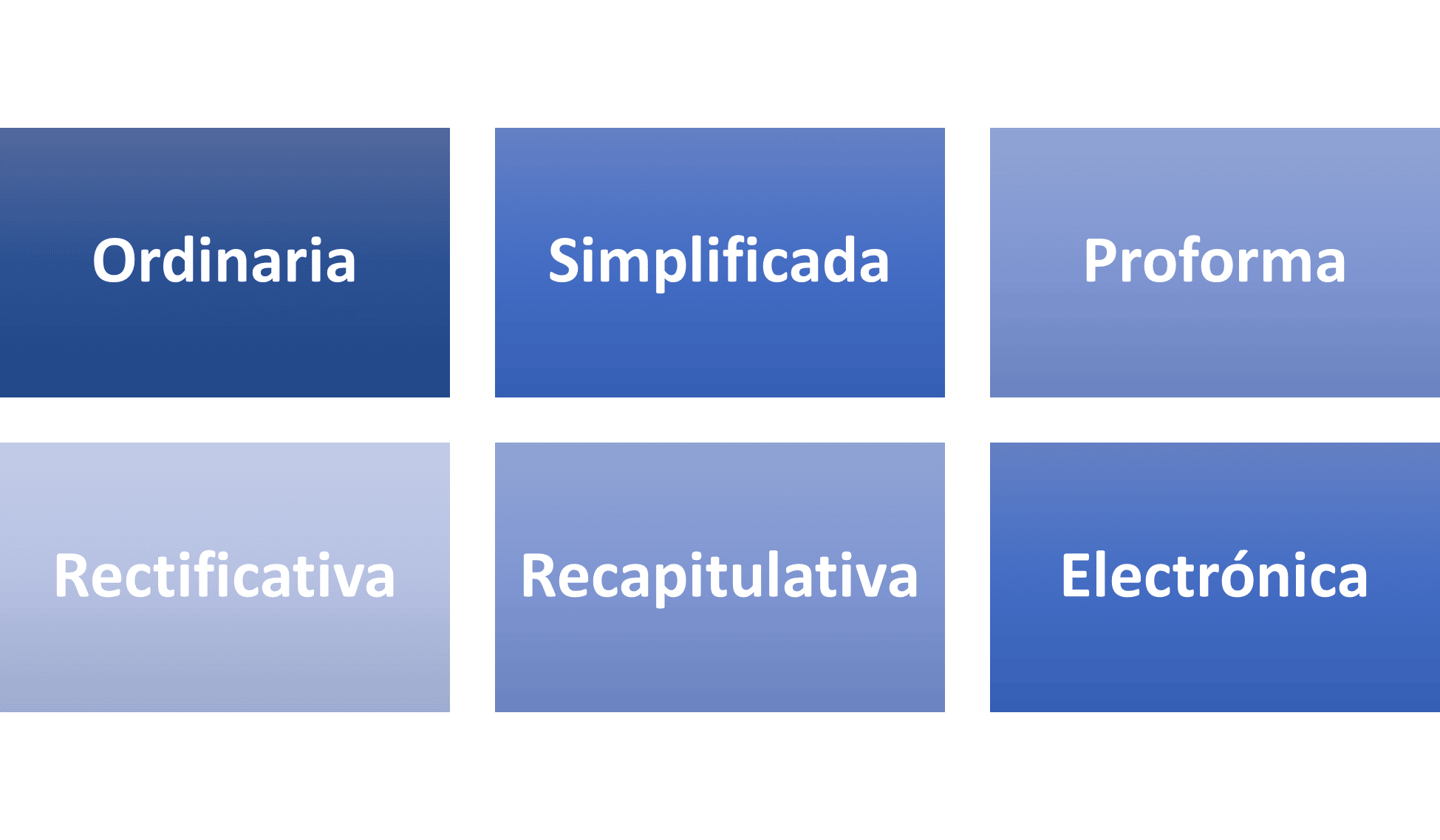
There are six types.
Want to know what they are?
Standard
This is the most common type of invoice and the one we’re all familiar with.
It serves as physical proof of a commercial transaction, whether for goods or services.
It must be numbered sequentially and contain information about the transaction.
Specifically, it must include the issuer, recipient, amount (distinguishing between the taxable base and the sales tax), description, and date.
Simplified
This is what we commonly call a receipt.
Its main differences from the previous type are:
- – It does not usually include the recipient’s information.
- – VAT is not itemized, so it includes the phrase “VAT not included.”
Its issuance is prohibited for distance sales, intra-Community supplies of goods, and reverse-charge transactions.
Pro forma
It is, in fact, a quote or commercial offer with no tax implications.
As a result, it is generally not valid for collecting payment or issuing advance invoices, nor should it be recorded in accounting.
It is characterized by the fact that it does not imply an obligation or a guarantee of purchase.
It contains the same information as regular invoices, but its numbering must be different.
It is used as a preliminary step when applying for government grants or financing, as well as in international transactions, serving a documentary purpose.
To collect payment on these invoices, you need the recipient’s agreement to record them as ordinary invoices.
Corrective Invoice
It is used to expand or correct standard invoices that have already been issued.
Regulations stipulate that no issued invoice may be modified; therefore, as an alternative, these must be created.
Depending on how they are prepared, they can replace and supersede the original invoice, or supplement it.
They must be issued as soon as the error is detected.
After four years, it will no longer be possible to do so. This is the VAT statute of limitations!
Summary Invoice
This allows you to group transactions with the same party within a single calendar month.
It is treated as a standard return, so it must include the same information.
In addition to the total amount, a brief description of each included transaction must be provided.
When appropriate, advance payment of invoices of this type is often quite advantageous.
Electronic
It is identical to the conventional form and has the same legal validity and content.
Its legal effects are the same, except that it is issued and received digitally.
It must include an electronic signature that validates its content.
The requirements for legibility, authenticity, and no modifications also apply to them.
In practice, you can issue these invoices in advance and collect payment just as you would with physical invoices.
The Importance of Collecting Payment on Time
Payments rarely wait.
The financial viability of your business depends on collecting payments on time so you can cover all required expenses.
No matter how many future collections we have coming, we need to meet the required payments as they come due.
When that’s not possible, short-term financing seems like the only option.
But that’s not true.
There’s always the option of invoice factoring.
In fact, invoice factoring is the most attractive option when your financial problem stems from a mismatch between collection and payment dates.
That said, it’s usually better to use mechanisms to bring forward this income than to take out conventional financing.
If you work or plan to work with government agencies or large private companies that pay on a long-term basis, this approach is right for you.
You’ll have the peace of mind of having your money when you need it:
- The timing of when you collect those invoices will depend largely on you.
Invoice advances come with a cost that you know in advance, so you can decide when to use this service while taking that expense into account.
Learn more about this option and discover its many advantages.