

1. How Can a Startup Get Funding?
Having access to appropriate sources of funding is vital for newly established companies.
These organizations need ongoing funding to drive their projects forward.
Their revenue is still in its early stages, and they need to buy time, so securing urgent business financing is a highly recommended option.
Given the fragility of these companies, a miscalculation or a poor choice of funding sources can dangerously undermine the company’s economic and financial situation.
2. Why Do New Companies Need More Funding?
Startups start from scratch and must compete with established companies in the market.
The investments required—regardless of the type of business—are constant.
For example, some of the fixed costs these companies face when launching their operations include the following:
- – Acquisition of necessary assets.
- – Payment for facilities and utilities.
- – Initial payroll.
- – Purchase of raw materials.
- – Storage and transportation.
- – Investment in advertising, communications, and promotion.
In addition to standard day-to-day costs, you must also take into account costs specific to each business launch, such as creating a website, designing a logo and corporate identity, or purchasing delivery vans, etc.
The main problem is the initial lack of revenue.
Even if the company secures contracts, clients, and orders, revenue will take time to materialize.
Therefore, securing urgent financing must be a priority for the project’s development and continuity.
3. Recommended Sources of Funding
Starting a business requires capital, and often many entrepreneurs do not have the necessary resources to get their project off the ground.
That’s why it’s very important to know what financing options are available to us.
Surely, at first, the most conventional options will come to mind:
Turning to a bank or people you know to obtain funds.
However, startups aren’t an attractive market for banks because they’re newly established.
That’s why we’ve listed the most suitable funding sources for these organizations below.
3.1 Equity
Equity refers to the money or resources that a company’s owners or founders contribute to the business. They typically contribute their personal assets, but these are not unlimited, so they need to seek out outside capital.
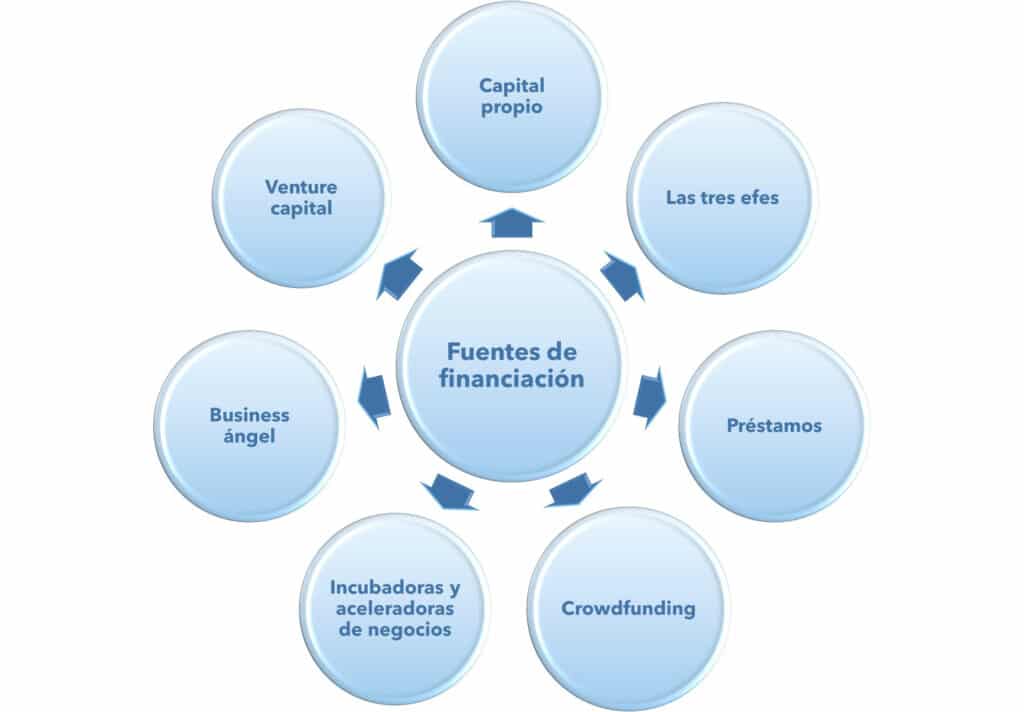
3.2 The Three Fs
“Friends, family, and fools” are English terms that refer to friends, family members, and “fools.”
They usually make up the inner circle you turn to first in your search for financial support.
The advantage? They charge no interest—or very little—and offer very flexible repayment terms.
The danger is that you’ll mix your professional life with your personal life, which can lead to misunderstandings and arguments with those closest to you.
3.3 Loans
This is a transaction in which an entity (lender) grants, through an agreement between the parties, an asset—usually money—to another entity (borrower) in exchange for interest.
Equity-based loans are a widely used alternative for startups. Among the advantages, we highlight the following:
- – The return (interest) is tied to the borrowing company’s profit growth
- – Interest is deductible for corporate income tax purposes
- – Repayment is typically long-term and often includes a grace period
3.4 Crowdfunding
Crowdfunding is a form of online financing based on collective contributions from numerous investors.
Types of crowdfunding:
- – Investmentcrowdfunding (Crowdinvesting):
The return does not have to be financial; it can take the form of shares, profits, or equity in a company.
- – Reward-basedcrowdfunding
In this case, a reward is offered in exchange for contributions in the form of products, services, or experiences.
- – Lendingcrowdfunding (Crowdlending):
In this type of crowdfunding, interest is applied to the contributions received; that is, the recipient of the funding will repay the money received plus the agreed-upon interest rate.
Since these are loan transactions, they require a more thorough review of documentation (business plan, financial information, etc.), and the funding process takes longer than in the other types.
- – Donation-basedcrowdfunding
In this type of crowdfunding, the people who fund the project receive nothing in return. Donors contribute funds for the sole purpose of helping the project move forward. These are typically charitable or humanitarian projects.
3.5 Business Incubators and Accelerators
Business incubators are centers that help startups develop and launch their business ideas by offering support and services in the areas of management, finance, marketing, and networking during the early stages.
Business accelerators are institutions that guide startups as they establish themselves.
During this process, they are trained and guided in business knowledge and technical aspects to help expand the project.
In addition, they enable entrepreneurs to expand their professional networks by presenting their ideas to potential investors.
3.6 Business Angel
These investors provide capital, experience, and contacts to entrepreneurs with the goal of obtaining a stake in the company and future returns.
Generally, they get involved with companies in the development phase, take an active role in the business to add value, and invest in sectors they are familiar with.
Another very common characteristic is that they remain anonymous to third parties.
Therefore, they are not speculators seeking a return on capital, but rather become part of the project by contributing their expertise.
3.7 Venture Capital
Another way to finance a startup is through venture capital firms.
These are venture capital firms that purchase shares in young companies with high growth potential.
In general, these firms focus their investments on business models in cutting-edge sectors such as biotechnology, information technology, and artificial intelligence.
They have greater influence on business strategy than investors or business incubators due to the large amounts of capital they inject into the company, and their goal is to sell the acquired shares at a high return.
Since there are several sources of financing available to launch your business venture, we recommend that you choose the one that best suits your needs.
At Workcapital, we offer business financing that is highly recommended for startups, providing you with experienced professionals who will assist you throughout the process and tailor the financing to your specific circumstances.
We also assist you through our promissory note discounting and invoice advance services, providing you with immediate liquidity in a fast, transparent, and straightforward manner.
Contact us with no obligation!