
Legal Requirements for a Promissory Note (Updated 2025)

💬 Here's everything you need to know about the legal requirements for a promissory note
❓ What exactly is a promissory note, and what is it used for?
It is a commercial document through which a person or company (issuer) agrees to pay a sum of money to another (payee) on a specified date. It is used as a means of payment and as collateral in commercial transactions.
🧾 What are the minimum legal requirements that a promissory note must include?
It must contain:
• The word “Promissory Note.”
• Name of the payee.
• Amount payable.
• Due date.
• Place of issuance.
• Date of issuance.
• Issuer’s signature.
Without these elements, the promissory note may lose its legal or enforceable status.
📅 What happens if a promissory note does not include a maturity date?
In that case, it is considered payable on demand, which means the payee can demand payment at any time after it is issued.
📍 Is it mandatory to specify the place of payment?
Not always, but if it is not specified, payment is deemed to be due at the issuer’s address. This can affect claims and jurisdiction in the event of nonpayment.
⚠️ Is an unsigned promissory note valid?
No. The issuer’s signature is essential for a commitment to pay to exist. An unsigned promissory note has no legal validity and cannot be used to claim the amount owed.
🔎 What happens if any of the legal requirements are missing?
It may still be considered a debt instrument, but it will lose its status as an enforceable instrument. This complicates the collection process, prolonging the timeline and legal proceedings.
📈 Do promissory notes need to be stamped to be valid?
Not always, but if they are promissory notes payable to order, they do require a revenue stamp to be enforceable. Without a revenue stamp, the note must be regularized before a claim can be filed or the note can be discounted.
🧭 Who is responsible for verifying the promissory note’s requirements before accepting it?
The beneficiary. It is essential to verify that the promissory note meets all legal requirements, is properly signed, and, if applicable, is duly stamped before using or discounting it.
In today’s business world, promissory notes are key instruments for formalizing payment commitments and facilitating smooth commercial transactions. However, their validity and effectiveness depend on compliance with a series of legal requirements that are not always met. In this article, we provide a clear and practical overview of the essential requirements for a promissory note, their implications for both the issuer and the payee, and how to ensure the document is properly drafted to avoid legal surprises.
📄 What Is a Promissory Note?
A promissory note is a commercial document through which one person (called the issuer or signatory) unconditionally agrees to pay a specific sum of money to another person (called the payee or holder) on a future date.
This document is governed by Law 19/1985 of July 16, on Bills of Exchange and Checks.
What is it used for?
— Commercial transactions: Companies use them as a form of deferred payment.
— Financing: They can be discounted at financial institutions (sold in exchange for an advance payment).
— Payment guarantee: They serve as a formal and legal commitment to third parties.
📂 Types of Promissory Notes
It is a financial tool widely used by both businesses and individuals to defer payments securely. But not all promissory notes are the same. There are different types depending on the form of payment, their use, transferability, or the guarantees they offer.
Below, we explain the main types of promissory notes so you can determine which one is best suited for each situation.
By payment method
— On demand: Payment is made as soon as the promissory note is presented for collection.
— Due a certain number of days after presentation: The due date is set a certain number of days after the promissory note is presented (for example, “30 days from presentation”).
— Payable a certain number of days from the date of issue: In this case, the term begins on the date the document is signed (for example, “payable 60 days from the date”).
— With a fixed maturity date: A specific payment date is set, such as “maturing on June 15, 2025.”
Depending on its use
— Commercial: Used in transactions between businesses as a form of deferred payment for the purchase of goods or services.
— Financial: Issued by financial institutions to raise funds. They function similarly to a time deposit, as they offer a return in exchange for the money lent.
Based on their transferability
— Registered: Issued in the name of a specific individual or company. It can only be cashed by that person, unless it is endorsed.
— To Order: Allows transfer to third parties by endorsement, making it more flexible and negotiable.
— Bearer: Can be cashed by anyone in possession of it. Although they are rare and more heavily regulated, they still exist in certain contexts.
By type of security
— Guaranteed: Includes the signature of a third party (guarantor) who agrees to pay in the event of default by the issuer. This provides greater security to the payee.
— Unguaranteed: The sole party obligated to pay is the signatory. Its use is more common when there is prior trust between the parties.
📋What legal requirements must a promissory note meet?
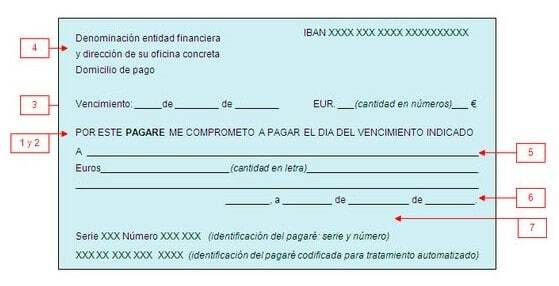
The legal requirements for promissory notes can be found in Article 94 and following of the Bill of Exchange and Check Act, with the following being essential:
— The term “promissory note” must appear in the text of the instrument itself. The word “promissory note” may be written in Spanish or in any regional language, but the entire promissory note must be written entirely in the same language. (*1)
— A pure and simple promiseto pay a specified amount in the official currency. This amount must be expressed in both numbers and words, and the two must match to ensure the promissory note is not invalidated. (*2)
— The indication of the due date. This is the date on which the promissory note is to be paid; it must always be a specific, feasible, and certain date. (*3)
— The place of payment, which is the location where payment is to be made. (*4)
— The name of the individual or legal entity to whom payment is to be made, referred to as the payee/drawee. (*5)
— The date and place where the promissory note is signed (date of issuance). (*6)
— The signature of the issuer of the instrument, who is the person or entity obligated to pay it upon maturity. When the issuer of the promissory note is a corporation, the person signing on its behalf must indicate the name of the entity they represent—either by writing it out or by affixing the company’s seal or pre-signed signature next to their own signature—so that the corporation is the party obligated to make payment. (*7)
✒️ What Is the Endorsement of a Promissory Note
An endorsement is a clause written on the promissory note by which the endorser or assignor (holder of the promissory note), through their signature and seal, transfers to a third party or assignee (endorsee) all rights arising from the promissory note, thereby becoming liable for payment from that moment onward.
It is primarily used to assign the collection rights granted by a promissory note. In other words, in exchange for a certain amount, a financial institution advances me the funds equal to the value of that promissory note before its maturity date.
There is no limit to the number of endorsements as long as they can be made. Each endorser becomes a party liable under the bill of exchange and a guarantor of payment.
Endorsed promissory notes, provided they are part of a valid and unbroken chain of endorsements, grant the final holder the right to collect as the rightful owner.
How to Endorse a Promissory Note to Obtain Early Liquidity
— In the case of promissory notes payable to order:
To endorse a promissory note, you must add the following phrase to the document:
“Pay to…” followed by the beneficiary’s name.
However, the most common type of endorsement is the “to bearer” or blank endorsement, which consists of a promissory note that does not specify the name of the new beneficiary and includes only the endorser’s signature and stamp on the back of the promissory note.
With this type of promissory note, the new beneficiary may take three actions:
— Fill in the blank endorsement
— Endorse it again
— Or make the promissory note payable to a third party without completing the endorsement and without endorsing it.
— In the case of promissory notes not made out to order or direct debit payments:
These are not documents that can be transferred to third parties by endorsement; they can only be transferred by assignment of the claim.
The assignment of the claim involves providing the issuer with reliable notice that the endorsement will take place, informing them that their debt is now owed to our financial institution and not to the party to which it was originally issued.
As long as the drawee has not been notified of the assignment, the drawee may pay the original creditor and is thereby released from the obligation to pay the new creditor (assignee).
If, upon notification of the assignment, the debtor does not promptly and expressly object to the assignment, it is deemed to have been consented to, even if only tacitly, and is obligated to pay the new creditor (assignee) as of the date of receipt of the notice; any payments made to the former creditor are not considered valid.
How to void an endorsement that has already been made
If, after endorsing a promissory note, you wish to cancel that endorsement, the correct way to do so is as follows:
You must cross out the endorsement to be voided and write the following paragraph below it:
“The preceding endorsement is crossed out for the purposes of Article 19 of the LCCH”
How to Correct an Incorrect Endorsement
You must be very careful when filling out the required information on each promissory note to prevent it from being voided, and the endorsement must be done correctly, following the proper order. If it is endorsed incorrectly, it will not be accepted.
What happens if you make a mistake when endorsing a promissory note?
As in the previous case, you must cross out the endorsement to be voided and write the following paragraph below it:
“The preceding endorsement is struck through for the purposes of Article 19 of the LCCH.”
The endorsement should then be rewritten by adding the following phrase to the document:
“Pay to…” followed by the beneficiary’s name, or the more common form of endorsement, which does not include the new beneficiary’s name and consists only of the endorser’s signature and stamp on the back of the promissory note.